Global Perspectives on Data Justice: Highlights from the EDI Townhall 2026
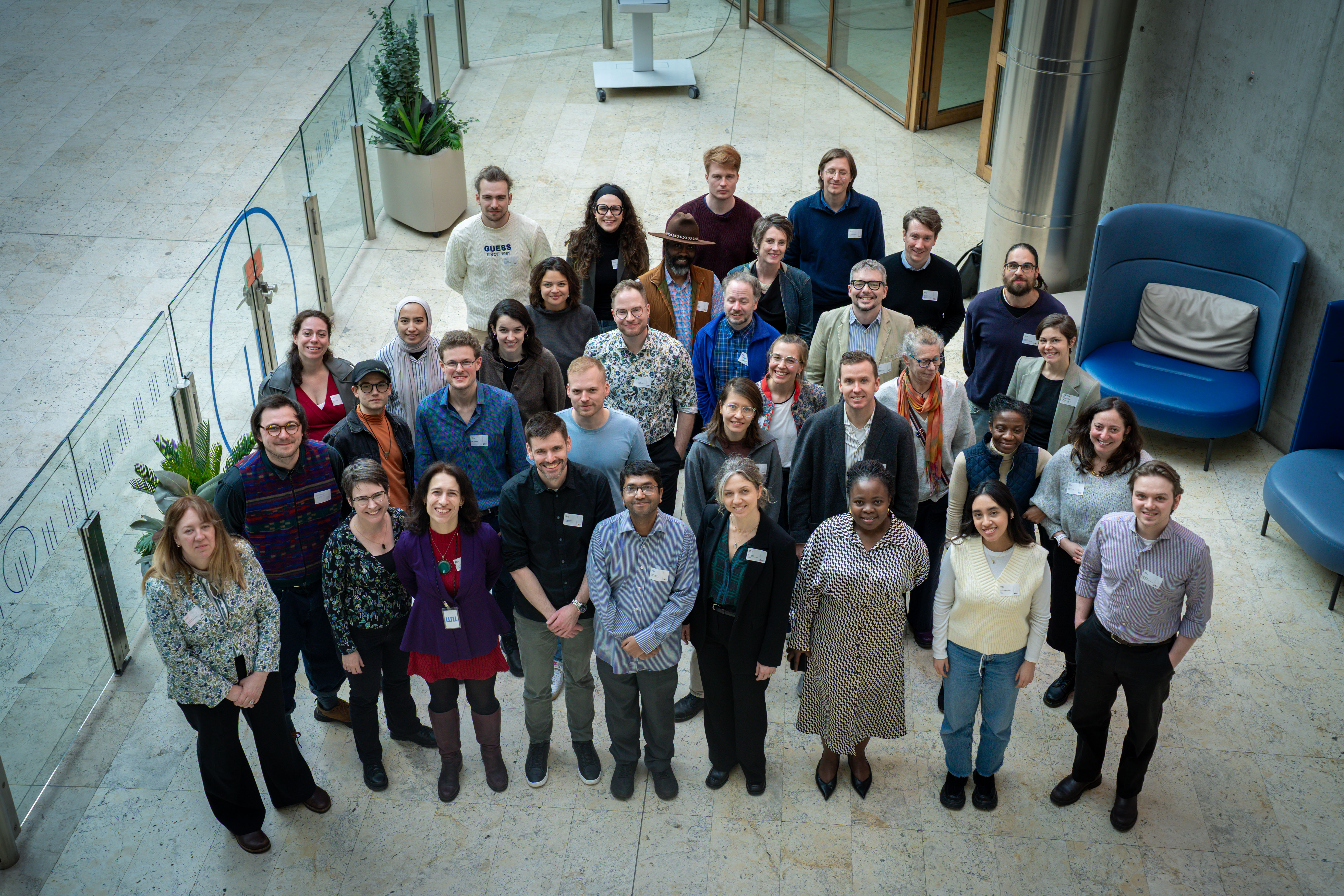
The Ethical Data Initiative (EDI) recently hosted its 2026 Townhall, bringing together a global community of scholars, policymakers, industry and activists to discuss the evolving landscape of responsible data practices. This year’s gathering, at the TUM Think Tank offices in Munich, was particularly significant as it marked the transition to a biannual event format, designed to foster deeper interaction between the EDI and its global network of stakeholders.
Grounding Data Ethics in Practice
EDI Director of Research, Prof. Sabina Leonelli, opened the sessions by redefining the very foundation of the initiative’s work. She argued that data ethics must move beyond abstract principles to become an “ethos of practice”.
“Values, and decisions about what we take data to be relevant for—and how to use them as evidence—are absolutely grounded in human decision making at every step of the way.”
– Prof. Sabina Leonelli, Ethical Data Initiative
Prof. Leonelli challenged the prevailing “artificial intelligence avalanche,” noting that the hype surrounding AI often sidelines critical questions about the data underpinning these technologies. She highlighted the growing “data scarcity” in the majority world, which creates a dangerous skew in AI modelling toward serving only small, wealthy populations.
Policy and Engagement, Education, and Research
The Townhall provided vital updates across the EDI’s three foundational pillars, demonstrating a robust expansion of the network to over 450 active affiliates.
Policy and Engagement The EDI’s policy team is spearheading the integration of data ethics into higher education, most notably through strategic campaigns with the Association of African Universities. Beyond academia, the initiative is deeply embedded in research integrity efforts, collaborating with the European Commission and UK Research and Innovation (UKRI) to develop frameworks for responsible data sharing. Central to this advocacy is the data sovereignty crisis; the EDI provides a critical mechanism for researchers in the majority world to engage with the digital economy on equitable terms.
The initiative’s impact is further amplified through close partnerships with research funders on Diversity, Equity, and Inclusion (DEI) and Responsible Research and Innovation (RRI). In June 2025, the EDI, alongside the European Commission, the Coalition on Advancing Research Assessment (CoARA), and the European Network of Research Integrity Offices (ENRIO), hosted a pivotal conference in Brussels. Titled “Advancing Responsible Research Assessment for Funders in the European Digital Space,” this dialogue on ethics and open infrastructure served as the precursor to the high-level EU Conference on Reforming Research Assessment held under the Danish Presidency in December 2025. Key outcomes included strengthening the Coalition for Advancing Research Assessment (CoARA) principles, addressing research career evaluation, and integrating broader, more diverse, and qualitative indicators, supported by new evidence on international funding practices.
Education A flagship of the education pillar is the “Data Clinic” format—a pioneering pedagogical approach where students work directly with partner organisations like the Rwandan Center for Law and Innovation to solve real-world ethical challenges. The team is also developing “Data Stories,” which use creative media and fictionalised research-based narratives to make complex ethical concepts accessible to a wider audience.
The EDI Education team leads highlighted results and achievements from the past year’s clinics that emerged from challenges posed by collaborators and were grounded in real-life situations reported by data workers, practitioners, or communities. Participants, both online and in the room, shared new insights and suggestions for further developing this educational and collaborative work and extending it to other formats and learner groups. These fruitful exchanges will help the EDI and our partners continue to foster wider cultures of ethical data work through innovative educational formats.
Research Current research spans the social challenges of facial recognition and recommender systems, to the ethics of “big textual data” in psychotherapy. The EDI is also focusing on “environmental intelligence,” reimagining how data and AI can be used to promote planetary health and a just society.
Research Spotlight: Recommender Systems for Social Good
A major highlight of the event was the synthesis of the workshop held on March 11, titled “Recommender Systems for Social Good”. Led by Dr Silvia Milano, the workshop challenged the traditional “accuracy-first” paradigm of recommendation algorithms.
Dr. Milano advocated for a conceptual shift that views recommendation as a “normative choice architecture”. The workshop explored how these systems, which mediate almost every aspect of modern life, from e-commerce platforms to research access via tools such as Google Scholar, can be optimised for pro-social goals such as fairness, diversity, and autonomy rather than mere commercial engagement.
Strategic Global Partnerships and Interdisciplinary Crossovers
The EDI Townhall 2026 highlighted the strength of its collaborative network, bringing together organisations that bridge the gap between policy and boots-on-the-ground research practice. These partnerships represent a shared commitment to restructuring the global data landscape.
The EDI’s mission is amplified by its prestigious global partners, who shared updates on their intersecting work:
The Research Data Alliance (RDA)
The partnership with the Research Data Alliance (RDA) remains a cornerstone of EDI international strategy. Connie Claire provided updates on a major global community consultation regarding the role of Generative AI (GenAI) and “AI Agents” in research. This consultation identified priority tools, such as “Literature Librarians” and “Data Directors,” which could help automate metadata creation to ensure data remains compliant with FAIR and CARE principles.
The most significant crossover is the upcoming launch of a dedicated Interest Group on Data Ethics under the RDA framework, in collaboration with the EDI, CWTS Leiden, CODATA, and the World Data System. This collaboration aims to consolidate RDA’s work on data ethics and create a dedicated space to bring together global efforts on this urgent challenge.
CODATA International Data Policy Committee (IDPC)
The EDI works in close alignment with the International Science Council’s CODATA International Data Policy Committee, co-chaired by Professor Virginia Murray and Professor Burcak Basbug. A primary focus of the IDPC in the coming year will be the development of Data Policy for Times of Crisis, a topic accelerated by the lessons of the COVID-19 pandemic and recent catastrophic earthquakes. The committee has produced a suite of resources, including fact sheets and guidance documents, to ensure that data remains open, reliable, and ethical during global emergencies.
The crossover between the EDI and CODATA is rooted in the “Data Policy for Times of Crisis” (DPTC) framework. Both organisations advocate for the use of UNESCO Open Science recommendations to facilitate rapid, ethical data mobilisation. By integrating EDI’s focus on “human-centric data science” with CODATA’s policy expertise, the partnership ensures that emergency data management does not bypass ethical safeguards in the name of urgency.
Italian National Supercomputing Center (ICSC)
Representing the technical infrastructure of the future, Davide Salomoni, Innovation Director of the Italian National Supercomputing Center managed by the ICSC Foundation, shared updates on the convergence of High-Performance Computing (HPC), Cloud, and AI. ICSC is currently hosting the “Italian AI Factory,” one of the largest initiatives of its kind in Europe, focused on building sovereign AI models. They are also pioneering “Digital Twins” in sectors such as health and climatology to simulate and solve complex societal challenges.
Leiden Centre for Science and Technology Studies (CWTS)
The CWTS at Leiden University, a world leader in bibliometrics and research evaluation, is working to dismantle non-transparent assessment systems. Senior Research Fellow, Dr. Louise Bezuidenhout, highlighted their role in the Barcelona Declaration onOpen Research Information, which advocates making openness the default for the information used to judge research quality. CWTS has transitioned its own famous “Leiden Ranking” to a fully open edition using OpenAlex data, providing a more inclusive view of global science.
Declaration on Research Assessment (DoRA)
DoRA continues its evolution from the 2013 San Francisco Declaration to a global initiative. Programme Manager Giovanna Lima discussed recent activities, including the launch of a jargon-free introductory course on responsible research assessment and a practical guide for research-performing organisations. DORA is currently expanding its reach in the Asia-Pacific region and partnering with organisations such as the International Science Council in its ongoing efforts to reform the scholarly publishing ecosystem.
DoRA and the EDI are collaborating on topics such as research governance reform and responsible research, through initiatives like the Research Assessment for Ethics and AI Discussion Series. Both organisations recognise that researchers will only adopt ethical data practices if those practices are recognised and rewarded systematically.
Keynote: Reclaiming Authority with Local Contexts
“Colonialism is a structure, not an event. And so that means all the infrastructures that we use have colonialism embedded in them as well.”
– Prof. Jane Anderson, Local Contexts
The event concluded with a powerful keynote from Hop Hopkins and Jane Anderson of Local Contexts. Their work addresses the chronic problem of digital colonialism – the historical and ongoing extraction of indigenous knowledge without consent or attribution.Through their innovative system of Traditional Knowledge and Biocultural Labels and Notices, Local Contexts provides a tool for indigenous communities to reassert their cultural authority over data sitting in global repositories. “Colonialism is a structure, not an event,” Professor Anderson noted, explaining how their metadata interventions (such as those at the Library of Congress) are changing the very “plumbing” of institutional data systems. Hopkins encouraged the audience to view this not just as a technical fix, but as a radical social movement toward “data back” and true reparations for the global majority.
Data clinics are an interactive collaboration and teaching format designed to bridge theory and practice in the field of data governance and ethics. They bring together partners and practitioners with Masters students from TUM to work together in a structured way on real-world ethical challenges and decision-making processes.
The clinics run as part of the teaching program in the Chair for Philosophy and History of Science and Technology in the School of Social Sciences and Technology at the Technical University of Munich (TUM).
Goal: empower participants with actionable insights to handle complex issues like privacy, discrimination, transparency, and accountability, and thus foster wider cultures of ethical data work.
Invited partners: present a real-world challenge drawn from their actual data practices and issues.
Collaboration: student teams explore the challenge from multiple perspectives of data governance and ethics and develop tailored insights.
Short videos (approx. 2 minutes) that explore a specific case-study related to data-work and work through various ethical implications. The stories are grounded in real-life situations and research in the philosophy, history, and social studies of science.
Plan to create initial prototype data stories (1–2) in 2025.
Example topic: social and ethical implications of mandating particular file formats in data sharing archives.
Data Ethics Cluster on LabXchange
We are preparing a Data Ethics Cluster in collaboration with LabXchange, to be openly available on LabXchange’s science education platform. “Cluster” is the name for a structured, modular learning programme on the LabXchange platform. It will provide wide-ranging, learning resources on working ethically with data, to help learners explore the consequences and contingencies of each step on a data journey, and to deal with the conflicts that often arise between different values.
LabXchange has global reach, with most users based in majority-world countries, which aligns with EDI’s aim of making data ethics education widely accessible and usable, in order to serve low-resourced environments in particular.
Data Ethics Cluster:
informed by perspectives from the philosophy, history and social studies of science and technology;
prioritises interactive learning activities to help learners integrate data ethics into their everyday technical/practical work with data.
Individual learning activities can be combined into “pathways,” which are short, contextualized learning experiences. For example, “data ethics in agricultural research.”
Users will be able to customize pathways for their own purposes, including by combining data ethics learning activities with other elements on LabXchange.
EDI Website
Our website serves an educational purpose, explaining our approach to data ethics and compiling initial resources for students, practitioners, and more.


Leave a Reply